


Although it can be difficult, migrating to the United States from Jamaica is possible provided that the individual has the right information and assistance. Jamaican citizens have a variety of lawful entry and residency options available to them. The several immigration methods available to migrate to the United States will be briefly discussed in this post. Additionally, the information needed to make the process go as smoothly as possible will be provided.
A million people or so are granted Green Cards each year, making them new permanent residents of the country. Many of those individuals enter the country on an immigrant visa. To move permanently to the United States, one must receive a green card, also referred to as an “immigrant visa” or “lawful permanent residency.” Unrestricted employment is possible with a green card, which can also be renewed forever. Also, it offers a route to US citizenship. A green card is not available to everyone, and the application process can be costly and time-consuming. Instead, many people use transitory visas to go to the US to visit, work, or study. These visas, which are formally referred to as “non-immigrant visas,” are frequently renewable and valid for many visits, which may enable you to stay in the US for a number of years.
The Immigration Process
Once you are applying for an immigrant visa outside the United States, you will be required to complete and submit the necessary petitions and forms for the immigrant visa you wish to apply for. If a petition for a visa is granted, the National Visa Center (NVC), a division of the State Department will receive the application for further processing. In order to track visa applications, the NVC sends correspondence with instructions on how to set up a profile at the Consular Electronic Application Center (CEAC). The remaining steps of the procedure, including fee payment, are managed here. An applicant may register for their visa interview online if the NVC accepts a petition.
Medical Examination
Before the interview, a medical examination at Andrews Memorial Hospital in Kingston, the sole authorized location, is required to complete the application. All appointments must be scheduled through the hospital’s online scheduling system. For the medical appointment, you will require the following items:
- Your appointment letter for the visa interview
- Your id card
- Four (4) recent color passport-sized photos
- Glasses for reading (if used)
- A duplicate of your vaccination records
- All prescription bottles and/or the most recent prescription confirmation sheet (ds-260)
Without the documents listed above, the consular office will not be able to complete your application process and this will most likely cause a delay in the process. A page in the applicant’s passport will be printed with the visa’s approval information. The visa typically has an expiration date, and travel to the US must occur before this date. The holder is now able to reside and work in the country. A visa does not, however, ensure admission to the United States. Entry may be permitted or prohibited at the discretion of the Department of Homeland Security (DHS).
Types of Immigrant Visas
Student Visa
The opportunity to study in the United States is the reward for years of effort and commitment for many students. All students must apply for an F-1 visa to study in the United States unless they are citizens or green card holders. An F-1 Visa will give students the opportunity to live in the United States for a period of time while attending school, college, seminary, or conservatory. The first rule of the F-1 visa is to ensure that your reason for traveling to the United States is to study at an academic institution temporarily. The academic institution you wish to attend must be accredited and should be able to accept foreign students on F-1 visas. The F-1 visa is a non-immigrant visa, therefore, you can work but you will be restricted in where you can work and the type of work you can do.
F-1 Visa Eligibility
In order to qualify for an F-1 visa, you must:
- Apply to and be accepted into a program of study at a US institution with SEVP (Student Exchange and Visitor Program) approval. SEVP-approved institutions can be high schools, seminaries, private elementary schools, conservatories, or language schools in addition to universities.
- You must be a full-time student registered at the institution.
- You must be either skilled in English or engaged in classes that will help you become so.
- You must possess documentation that proves you have the money necessary to sustain your studies in the US.
- Considering that the F-1 visa program is a temporary visa, you must have ties to your home country that demonstrate an intention to return after your studies in the United States are finished.
- You must live outside the US at the time of application.
Diversity Visa
The Department of State oversees the Diversity Immigrant Visa program, which aims to broaden the diversity of immigrants entering the country. More than 50,000 randomly chosen individuals, only from nations that don’t send many immigrants to the United States, are granted permanent residency (commonly known as a “green card”) each year through the Diversity Visa program. It gives people and families who would otherwise be unable to legally immigrate to the United States the opportunity to do so.
To enter the Diversity Visa program, you have to complete a simple form online at no cost. You can enter the program every year and once you are selected you and your entire family will be given the opportunity to receive green cards and migrate to the United States. You will then have to pay the mandatory green card application fees. Seven months after submitting their entries, the winners of the Diversity immigrant visa are normally notified. Depending on how fast you apply for your visa, it may take up to 14 months from the time you are selected until your interview is set and you receive your visa.
How to Enter?
It’s really simple to participate in the Diversity Visa program. While it’s available, which is from the beginning of October to the beginning of November, you fill out a form on the State Department’s website. The majority of the questions are simple to grasp, however, in a few spots, the following additional advice is useful:
- Indicate your nation of birth in “country of birth,” regardless of where you currently reside. Use the country’s current name if it has changed from the name it had when you were born.
- Specify either your country of birth under “country of eligibility” or, if you’re eligible to use your spouse’s or parents’ countries of birth, that nation. This question has no bearing on the nation in which you presently reside.
- Your spouse: Even if your spouse doesn’t reside with you and doesn’t plan to immigrate with you, you must list your spouse.
- Your children: Regardless of their ages, you must include all of your biological children as well as all of your adopted children. Even if you are no longer married to their parent, you should still mention all of your stepchildren who are younger than 21.
You must also attach a current photo of you, your spouse, and your kids that was taken within the last six months. Observe the same guidelines for taking photos as when applying for a green card. Keep your confirmation number safe when you submit your application because that’s the only way to find out if you’ve been chosen.
Requirements for a Diversity Visa
Country of Birth
You must have been born in a nation that over the previous five years has sent less than 50,000 immigrants to the United States in order to qualify for the Diversity Visa. There are still two methods to be eligible for the Diversity Visa even if your country of origin is not one of them:
- You could apply together with your spouse and select their country of birth on your application if they were born in an eligible nation.
- You could select your mother’s or father’s country of birth if neither of your parents were a citizen of the nation where you were born.
Education
A high school diploma is a minimum criterion for Diversity Visa applicants, as is two years of work experience within the previous five years in a job that, as assessed by the U.S. Department of Labor, needs at least two years of training.
Family Visa
Jamaicans can get a green card to migrate to the United States if they are sponsored by a relative who is a U.S. citizen or a legal permanent resident however, the petition for the individual must be done by the U.S. relative. Jamaicans can migrate to the United States through their spouse, fiancé(e), parents, unmarried children, and legal U.S. citizens.
A Jamaican spouse and an American or legal permanent resident spouse can apply for a marriage green card together. Depending on whether the foreign partner resides inside or outside of the United States, the application procedure varies. Also, a K-1 visa, often known as a fiancé visa, enables an engaged American citizen’s spouse to enter the country as long as the wedding takes place no later than 90 days. It is a temporary visa that can be used to get married and start the application process for a green card based on marriage. Form I-129F (“Petition for Alien Fiancé(e)”) must be submitted by the relationship’s American citizen or lawful permanent resident to begin the procedure.
Work Visa
The largest economy in the world, the United States, is mostly fueled by immigrants. Foreign nationals who want to work in the United States have a variety of visa choices, including Temporary Non-Immigrant Visas, Permanent (Immigrant) Workers, and Temporary Business Visas.
Temporary Non-Immigrant Visas
A temporary Non-Immigrant Visa is given to persons who seem employed in the United States for a defined period of time. In most cases, for this type of work, a petition is filed by the potential employer with the US Citizenship and Immigration Services (USCIS). The employee will need to apply for a visa. There are various categories of workers within this qualification. Let’s take a look at some of the most common non-immigrant work visas:
H Visas
There are four types of H visas, each applying to a specific group of people. There is the H-1B visa and this visa is for people who are in a specified professional or academic field or they have special expertise, a college degree or higher, or an equivalent in work experience. A three-year residency limit applies to these visas. For one to be eligible for an H-1B visa, an employment offer from a US company for a position requiring specialized knowledge, evidence of a bachelor’s degree or its equivalent, and the business must demonstrate that there aren’t enough competent Americans applying for the position.
Other H visas include H-2A and H-2B. Both of these visas do not extend beyond a year and are for temporary seasonal, peak-load workers in agriculture (H-2A) or non-agriculture (H-2B) setting. In addition to those three visas, there is the H-3 Visas for those individuals who seek training in any field, excluding graduate medical school or training, or training to accommodate students who need special education. This category is for citizens who desire to receive their education in the United States but plan to pursue their jobs abroad.
I and L Visas
I visas are available to journalists, film crews, editors, and other eligible foreign press personnel who are working for a foreign media organization with a home office abroad, including print, radio, film, or other foreign information media. As long as the holder is employed in this field by the same employer, most people have an indefinite visa.
L Visas, on the other hand, are for those who are temporarily changing jobs inside an organization where they already work, either at the executive or management level (L-1A) or due to a specialty (L-1B). L-1B visas are only valid for one year, while L-1A visas are valid for three years.
O and P Visas
O visas are for those individuals with extraordinary and exceptional qualities or achievements, across industries, who are eligible for O visas. Those who travel with a person with the outstanding ability or a family member are also eligible for O visas.
P visas are intended for individuals who excel in performing, athletic, or creative pursuits as well as the individuals who are traveling with these exceptional performers. They are typically timeframes based on events.
Permanent Workers (Immigrant)
The approximately 140,000 employment-based green cards that are offered each year can be claimed for by those who have the necessary job skills, as well as by their spouses and kids. The correct mix of education, experience, eligibility, and skill set can lead to permanent residency in the United States. The majority of these visas require a current offer of employment from a business with the required U.S. Department of Labor certification, demonstrating that there are both inadequate American workers with these skillsets and that the hiring will not displace American citizens from their jobs. Five main categories of employment-based visas are as follows:
EB-1 and EB-2 Visas
These visas are first and second preference respectively. Those with “exceptional talent” such as those in business, academia, science, the arts, or athletics are covered by EB-1 visas. There is no need for a labor certification for this kind of visa. If the EB-1 visa holder has an approved I-140 (green card) form, the holder’s family members may petition for entry to the United States under the E-14 or E-15 immigrant status, respectively.
Professionals with advanced degrees or their foreign equivalents, those who can demonstrate at least ten years of relevant experience, and those whose job is in the U.S. national interest are all eligible for EB-2 visas. A labor certification is required for all eligible categories except the third. E21 or E22 visas are available for family members of EB-2 visa holders who wish to enter the country.
EB-3 Visas
Similar to the visas above, this visa is a third preference visa. Anyone with a bachelor’s degree, or its equivalent in a different country, as well as skilled and unskilled laborers who have a non-temporary job offer from a U.S. firm are eligible for EB-3 visas. It is necessary to obtain labor certification for each EB-3 eligibility category.
Temporary Visit for Business
These visas are meant for extremely short-term business trips. Such a visa would allow travel for purposes like contract negotiations, conference attendance, or estate administration. B-1 visas are given to people with brief, transient businesses in the US. They are time-sensitive and often granted for one to six months, with the possibility of an extra six months’ extension. These visas rarely last more than a year. Family members of B-1 visa holders cannot travel on these visas; they must apply for their B-1 visas to travel.
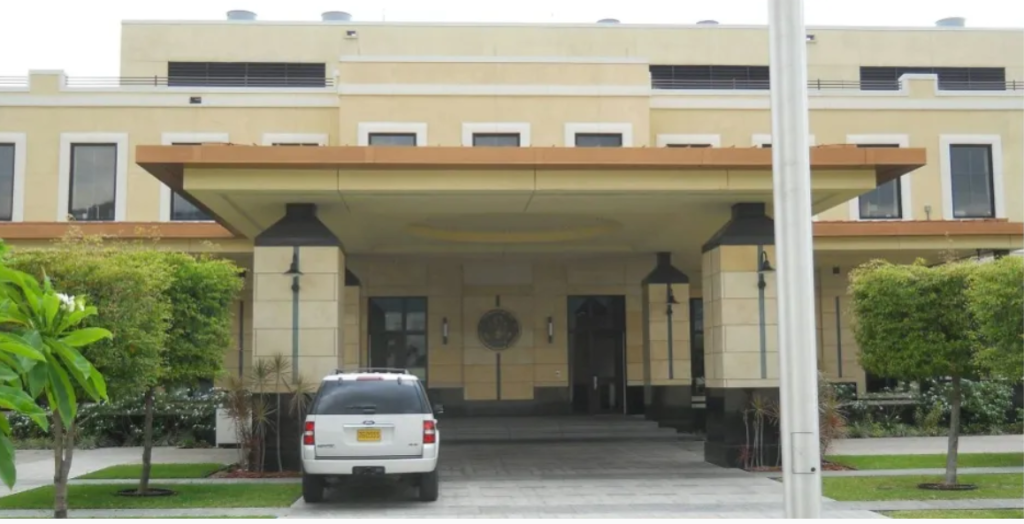
Embassy contact information:
U.S. Embassy Kingston
142 Old Hope Road
Kingston 6
Jamaica, West Indies
Email: KingstonNIV@state.gov
Tel: (876) 702-6000
Fax: 876-702-6348
